Insights · Field notes
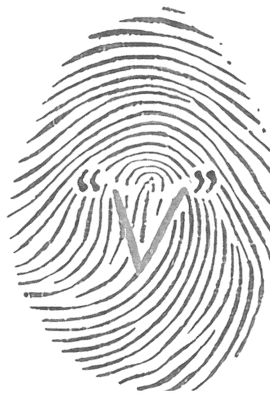
We build a company around making businesses visible to AI. So it is fair to ask why our mark is a fingerprint, the most human thing there is. This is the answer.
Published July 20, 2026
"The truth does not change according to our ability to stomach it."
Flannery O'Connor
There is a question worth asking about a company like ours. We spend our days making businesses legible to machines, helping AI engines recognize, read, and recommend them. So why is our mark a fingerprint? Why build a brand around the most human, least reproducible thing there is, in a business that is fundamentally about technology?
Because the technology is only worth anything if it serves the human underneath it. And in a moment when everything is accelerating, that is easy to forget.
From the founder
I've come to see AI less as something that replaces how we think and more as something that changes how fast we have to. It's useful, almost unfairly so, but it is still not human, and there are moments when that distinction gets very clear.
I notice it most at home. My kids are growing up in a world where answers are instant and tasks that took hours now take minutes. We're all more productive. But I wonder sometimes if we're also more distracted from what matters most. God, family, friends, and health do not move at the speed of technology, and they were never meant to. AI keeps accelerating what we can produce. It does not replace the value of being present while we are actually living.
I've had to adapt too, completing in minutes what used to take hours, meeting the expectation of faster output and constant iteration. But through all of it, one thing stays non-negotiable: core values cannot move at that speed. Technology will keep evolving and we'll evolve with it, but the foundation has to stay grounded. The question I keep returning to isn't whether AI should slow down or we should speed up. It's how we make sure that in all this acceleration, we don't lose the parts of life that were never meant to be optimized.
A fingerprint is the oldest proof of identity we have. No two are alike, not even among twins. It cannot be mass-produced, downloaded, or generated. It is the literal signature of a single human being. That is why we chose it, and it is not decoration. It is a reminder, to us first, of what the work is actually for.
Our business is helping AI engines find and recommend real businesses. But behind every business is a person, an owner who took a risk, a team that shows up, a reputation earned one customer at a time. The structured data and the citations are just the means. The end is making sure a real, deserving, human enterprise is not made invisible simply because it never learned to speak the machines' language. We translate the human into something the machine can read, without losing the human in the translation.
This is also why we are stubborn about honesty, why we score what is actually there rather than manufacturing alarm to sell a fix, and why we tell clients the truth even when a more convenient story would close the deal faster. Anyone can automate a sales funnel. A machine can generate confident promises all day. The human part, the part that cannot be optimized away, is choosing to be truthful when it costs you something. That choice is our fingerprint on the work.
AI will keep getting faster and more capable. That is good, and we use it every day. But the companies that matter in this next era will not be the ones that moved fastest. They will be the ones that stayed human while they moved fast, that remembered who the speed was supposed to serve. We named this company around vero, the root of "true," and marked it with a fingerprint, because the whole point is this: the technology should make true, human things more visible, not replace them.
Your CitedIQ score is a free, honest read of how visible your business is to AI today. No alarm, no inflated problems, just the truth about where you stand and what it would take to be the name the engines name.
Get your CitedIQ scoreRelated reading: why cited truth wins and the story behind the name. For definitions and the sources behind statistics we cite across the site, see our Start Here page.